ASEAN Future of Work Conference, 29 Sep 2020
Watch keynote addresses and panel discussions from the ASEAN Future of Work Conference, exploring how governments, employers, and workers can build a better post-COVID future.
Last updated 6 April 2026
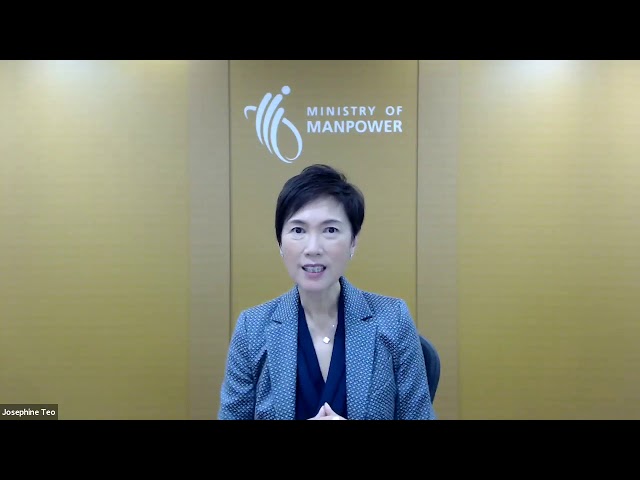
1. Keynote Address by Mrs. Josephine Teo, Singapore Minister for Manpower.
3. "Singapore’s Response to Address the Impact of COVID-19 on the Labour Market", by Mr Aubeck Kam, Permanent Secretary, Ministry of Manpower, Singapore.

5. Panel Discussion: “Building a Better Post-COVID Future of Work”
Moderator: Ms Diaan-Yi Lin, Senior Partner, McKinsey & Company
Panellists:
Mr Graeme Buckley, Director, DWT/CO-Bangkok, International Labour Organization
Mr Aubeck Kam, Permanent Secretary, Ministry of Manpower, Singapore
Dr Ha Thi Minh Duc, Deputy Director-General of International Cooperation Department, Ministry of Labour, Invalids and Social Affairs, Vietnam
Ms Lynn Dang, HR Lead, Microsoft Singapore
Mr Shoya Yoshida, General Secretary, International Trade Union Confederation – Asia Pacific
This session discussed the forces shaping a post-COVID future of work, and the different but crucial roles that governments, employers and workers must play in preparation of the future of work. It also discussed the need for social dialogue and regional collaboration to build inclusive and sustainable protection systems, as well as a culture of lifelong learning and care for workers’ mental health.

6. Panel Discussion: “Employment Facilitation Post-COVID, for a Better Recovery”
Moderator: Ms Aparna Bharadwaj, Managing Director and Partner, Boston Consulting Group
Panellists:
Mr Tan Choon Shian, Chief Executive, Workforce Singapore
Mr Gilbert Tan, Chief Executive Officer, Employment and Employability Institute
Mr Sim Gim Guan, Executive Director, Singapore National Employers Federation
Mr François Lançon, Regional President, Asia Pacific and Middle East, ManpowerGroup
Mr Daniel Robinson, Programme Director, Maximus
This session explored the future of work trends impacting employment facilitation and the various skills which are increasingly in demand in the changing economy. It also discussed how each tripartite stakeholder has a part to play in supporting businesses and workers to retain workers, address job and skills mismatches, and so achieve better employment facilitation outcomes.
